
Studio Critic: Igor Marjanovic, Elisa Kim
Site: Florence, Italy
Summer 2016
In response to the immigration crisis currently affecting Europe and the world, the studio was asked to envision a possible tenth island in the Tuscan Archipelago – and isle for world immigration – that responds and interacts with the broader cultural and social landscape.
Project Narrative:
As an aspiring 19-year-old young historian, Rajeed learned about events and stories of others, hoping that one day he could contribute to the collection of history textbooks. In fact, within just a few years, he did become part of what would become history. Due to instabilities and complications in his part of the country, Rajeed and his family had to leave their long-bound homeland, in search for refuge by crossing over the Mediterranean. Those few weeks and months on the road was life-altering for Rajeed – conditions were rough; journeys were life-threatening; people came and went… Upon arriving in Europe, Rajeed had a completely different life trajectory – he worked day and night, in order to continue his educational pursuit as a historian. Years went by and Rajeed finished school – the memories are still deep within his mind, but few of his peers on this new land knew of these moments of his life. It was then when Rajeed saw the value in recounting these indelible parts of his life – and the very meaning of his dream to become a historian –that if these stories and memories were never chronicled and recounted, they could easily be lost.
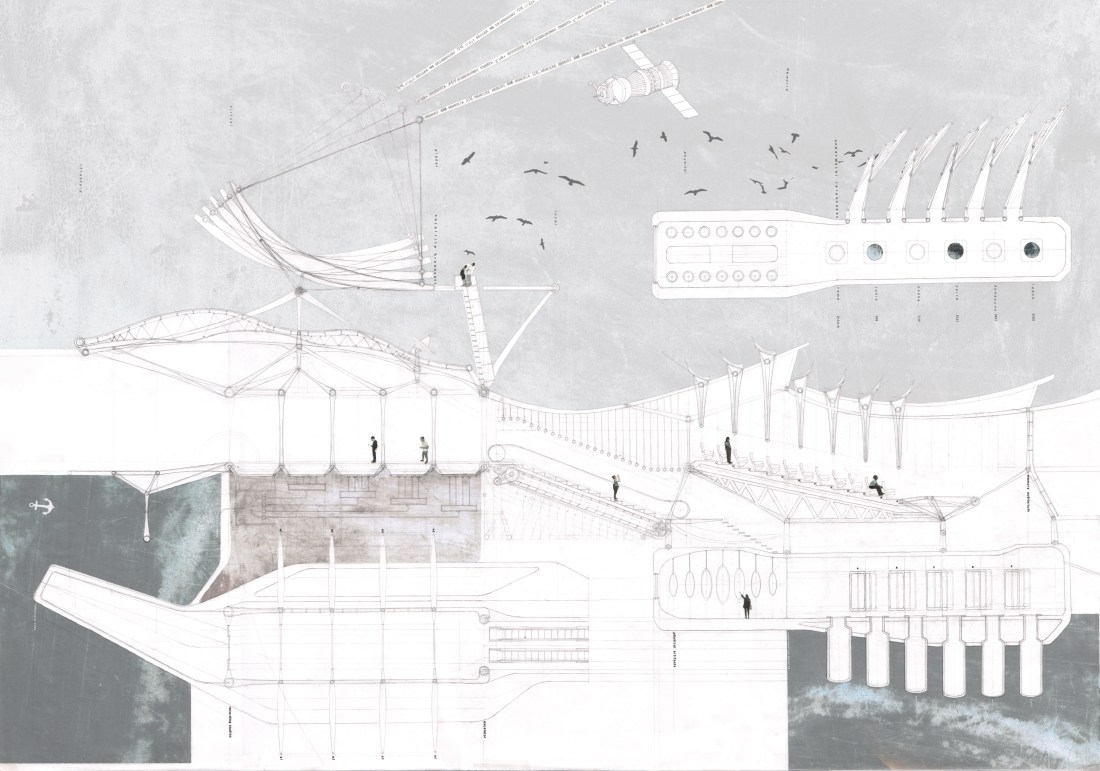
It is now 2046. Thirty years later, as an established contemporary historian, Rajeev was invited to help establish a “memory archive” – for the memories of refugees from all backgrounds and origins – along the Tuscan coastline of Italy. Both personal and collective, these otherwise easily unspoken and forgotten – yet highly valuable and meaningful – memories would be harnessed so that they could resonate with the former refugee community and beyond. This would be a place where people would feel comfortable of bringing in their memories, so that they could be recorded. Envisioned as an exchange node with inputs and outputs, the archive records both digital and physical artifacts and recollections and then share them through both satellites and optic fibers, as well as theater experience and physical display.


 George H. Zhang