Blog

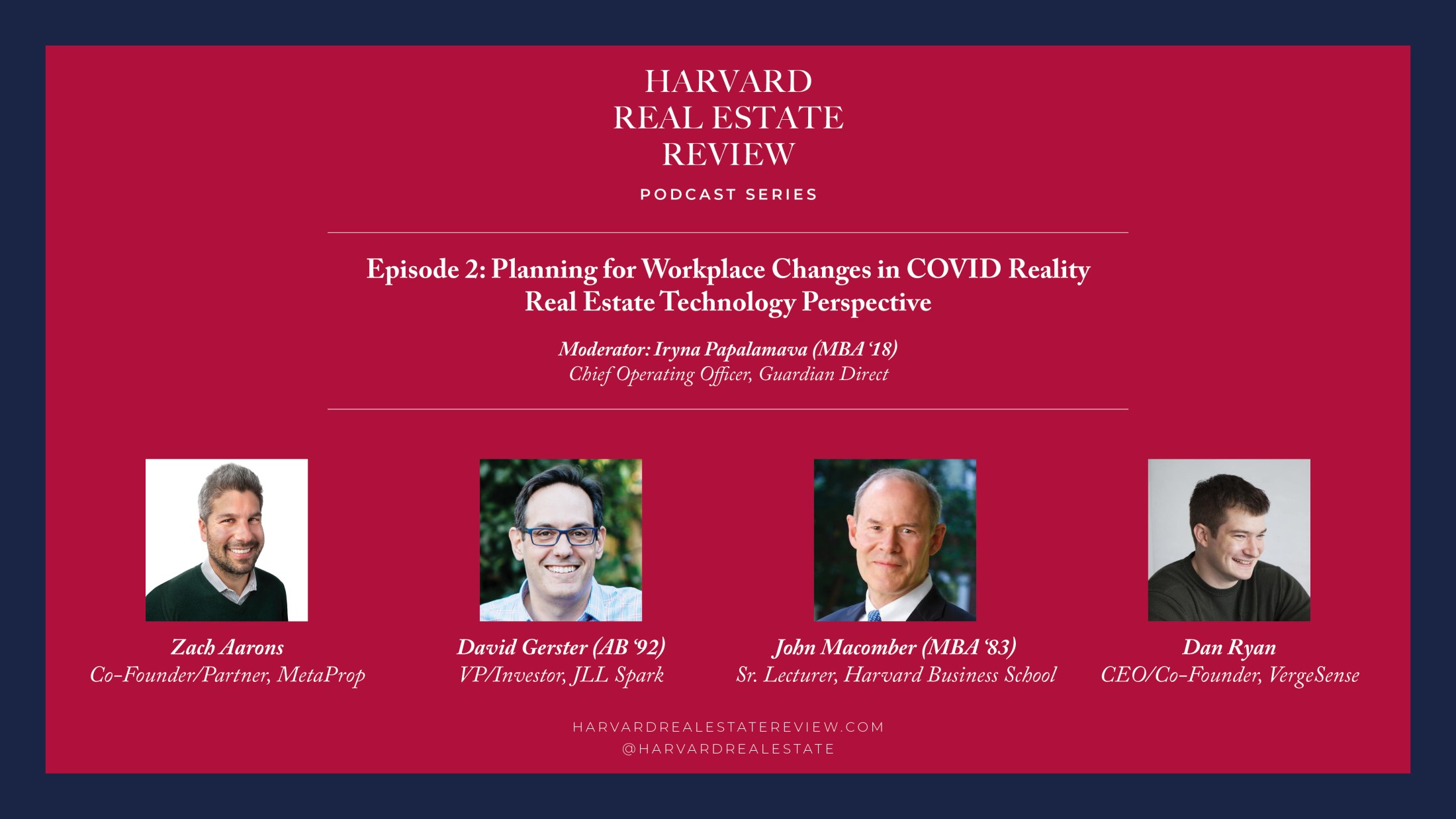
HRER Podcast #2: Planning for Workplace Changes in COVID Reality – Real Estate Technology Perspective

Tune in now on your platform of choice! (SpotifyiTunesGoogle PodcastsAmazon)

As COVID vaccines rolls out in countries around the world, we begin to see the light at the end of the tunnel, looking forward to having the pandemic behind us in the near future. While remote work is still the norm for now, many are yearning for a return to normalcy with in-person collaborations and interactions at offices.

With the lessons we’ve learned from COVID about the importance of healthy indoor spaces, we begin to envision what the post-COVID offices will look like, as well as how we can use technology, methodology, and strategy to make workplaces healthier, more productive, and more comfortable.

The following questions emerge: Who will return to offices first? At what point? Who will remain remote? What should entrepreneurs and investors know about opportunities in workplace real estate as some companies consider returning to back to physical offices? How can Fortune 500 CEOs plan for potential office return in 2021 while improving productivity and bottom-line?

This episode features a cross-disciplinary conversation between the following industry experts:

Zach Aarons (Co-Founder/Partner @ MetaProp.vc)

Zach is the Co-Founder and Partner at MetaProp VC. He has funded over 60 startups in the space as an individual and 50+ startups through MetaProp’s venture capital funds. Zach has also worked on large scale mixed-use development projects in Boston and Los Angeles with Millennium Partners. He is a co-author of PropTech 101 (proptech101.com) published by Advantage Media and has experience with real estate development, commercial asset management, property marketing, and commercial leasing.

David Gerster (VP/Investor @ JLL Spark Venture Fund)

David is an investor with the JLL Spark Global Venture Fund, a $100M early-stage proptech fund. He led JLL’s efforts for Eden, a $29M financing with JLL as the lead investor. He also led the investment for OpenSpace. Before becoming VC, David worked in data roles in the consumer web. At Yahoo, he led the project to collect billions of URL clickstreams from Toolbar and record them in Hadoop, creating data for multiple new features in production web search ranking. At BigML, David led the angel round in 2013, a full two years before Amazon and Microsoft launched their “machine learning as a service” products.

John Macomber (Senior Lecturer @ Harvard Business School)

John is a Senior Lecturer in the Finance unit at Harvard Business School. His professional background includes leadership of real estate, construction, and information technology businesses. At HBS, Mr. Macomber’s work focuses on the future of cities, particularly as aided by the private finance and delivery of public infrastructure projects in both the developed and emerging worlds. His teaching combines infrastructure finance (including public-private partnerships), investing in resilience (notably in the face of sea rise in some areas and drought in others), economic development, and the impact of new technologies in delivering new infrastructure and making old infrastructure more efficient.

Dan Ryan (CEO/Co-Founder @ VergeSense)

The conversation was moderated by Iryna Papalamava (MBA’18), previously a Director and Principal at Boston Consulting Group Digital Ventures (BCGDV), and currently a Chief Operating Officer at Guardian Direct. This podcast series emerged out of her article entitled “Picking Winners and Losers in PropTech,” a comprehensive guide for investing in real estate tech published in HRER Issue #8.

Dan Ryan is the founder of VergeSense. VergeSense is building an easy-to-deploy space utilization & sensing platform that helps real estate professionals monitor foot-traffic within buildings. Data from the VergeSense platform is used to improve building layout & design, execute dynamic workforce strategies, and reduce energy costs. VergeSense has been at the center of space planning conversations focused on helping companies comply with public health guidelines of social distancing, sanitation, among other applications. As companies plan the return to work for their teams, VergeSense is working to deliver a crucial service in this transitional time.

The HRER podcast series is produced by Dixi Wu and George Zhang, Editors Emeriti of the Harvard Real Estate Review and Executive Editors of HRER Issue #8.


PropTech x Workforce Housing?

Earlier this week, I was pleasantly surprised to come across an article on Propmodo by Brad Hargreaves, CEO of Common Co-Living who happened to be one of our panelists at the Harvard Real Estate Weekend two years ago (2019). He argues that the arms race for amenities and technology in high-end multifamily residential development has led to a saturation in the market segment in its use of technology. While not all of these technologies may be applicable or feasible with the more cost-conscious workforce housing, the boom and saturation of PropTech in luxury residential will mean that companies have to look to expand outside of this segment. As Brad noted, luxury only accounts for 20% of the entire multifamily market.

PropTech has saw tremendous growth and gained increasing mainstream recognition over the past few years, and the most notable headline from this past month perhaps goes to the latest news from Latch, a smart lock maker who will go public through a merger with TS Innovation Acquisitions Corp. (NYSE: TSIA), a special purpose acquisition company (SPAC) backed by Tishman Speyer.

While some of these technologies (smart home, for example) may seem like bells and whistles that are nice-to-haves to apartments, other technologies, such as _________ will actually further the affordability factor that benefit workforce housing.

In some mays, it may parallel the ongoing trend where Class A office buildings will tend to trickle down into the market. Filtering

Cover Image: Via Verde, an iconic mixed-income residential project in Bronx, New York developed by Jonathan Rose Companies and designed by Dattner + Grimshaw Architects.

New Year, New Start

Over the years, I have dabbled in blogging as well as regular writing in a few occasions: as the Editor-in-Chief of my high school’s online newspaper, as a student journalist for the Vancouver 2010 Winter Olympics, as a summer journalism student in 2011, and as a blogger for the Alberti Program, an award-winning educational program aimed at sharing the love of design with inner city children and youths.

That being said, these were all one-off efforts without long-term sustained production in writing. I consider myself a curious person (besides being called “Curious George” for many years at school), but with the many commitments and obligations that we all face day to day, sometimes it’s hard to distill one’s thoughts, let alone finding a channel to do so. I hope to use this opportunity to collect some of my thoughts and findings as I navigate myself into a whole new world at the intersection of design, business, policy, technology, and more.

Here’s my new year resolution: I will write or post, short or long, one post a day for 2021 – about my life, about what I’m reading or discovering, about what I’m working on, and more.

There will be a caveat, though: as we all know, life can get in the way (of many things). As I have recently learned in Atomic Habits, sometimes it’s okay to let yourself get off track (but never for 2+ days though). This way, there will be less guilt when that happens, encouraging a more positive mindset and ensuring sustainability in the long run. I guess this my way of prefacing that I might be off for a day or two (but, hopefully, never more than two.)

New Year, New Start. Here’s to a year filled with reflection and discovery!

HRER Podcast #1: Real Estate Tech 3.0 — Opportunities and Disruptions in COVID Reality

Real Estate Tech 3.0 — Opportunities and Disruptions in COVID Reality
Inaugural Episode, Harvard Real Estate Review (HRER) Podcast Series

Tune in now on your platform of choice! (SpotifyiTunesGoogle PodcastsAmazon)

PropTech has been the buzzword in the real estate industry for the past few years. People are looking for ways to disrupt this traditional industry whether through revolutionizing ways of living, changing mode of operation, or coming up with new models of investments. Post the 2008 financial crisis, disruptions now known as Housing and Homebuilding 2.0 — such as prefabrication, 3D printing, and smart home — came to the forefront of the industry. As people always say, with crises and challenges comes opportunities. Since the COVID pandemic, willingly or unwillingly, our social norm and way of living is changing faster than ever. In this episode, we will take a closer look at the macroscopic housing and real estate trends and how investors and businesses adapt to these changes.

This episode features a cross-disciplinary conversation between the following panelists and experts:

· Chris Herbert (Managing Director at the Harvard Joint Center for Housing Studies)
· David Gerster (VP and Investor at JLL Spark Venture Fund)
· Nicholas Donahue (CEO and Founder at Atmos)

The conversation was moderated by Iryna Papalamava (MBA’18), previously a Director and Principal at Boston Consulting Group Digital Ventures (BCGDV), and currently a Chief Operating Officer at Guardian Direct. This podcast series emerged out of her article entitled “Picking Winners and Losers in PropTech,” a comprehensive guide for investing in real estate tech published in HRER Issue #8.

The HRER podcast series is produced by Dixi Wu and George Zhang, Editors Emeriti of the Harvard Real Estate Review and Executive Editors of HRER Issue #8.

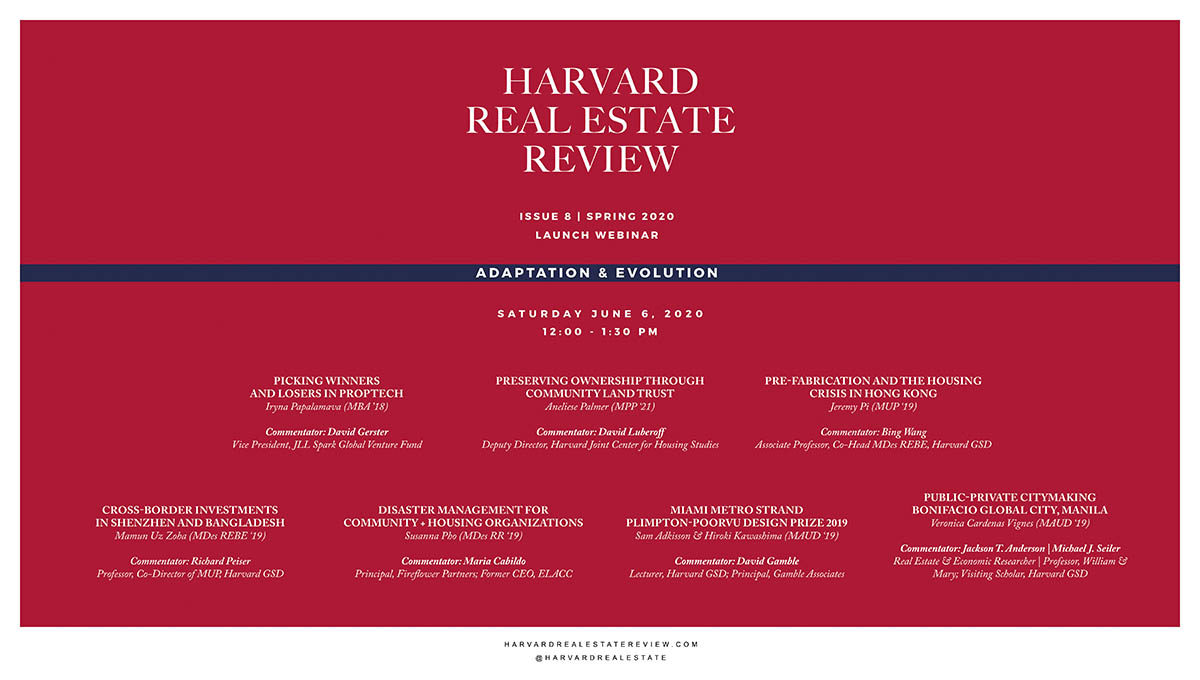
Harvard Real Estate Review: Issue 8 Launch Webinar

*Individual video segments available below.

The AY 19-20 Editorial Board of the Harvard Real Estate Review is pleased to present our recently published 8th annual issue, entitled “Adaptation and Evolution.” In lieu of our traditional in-person launch party, the remote nature of all communications these days has enabled us to gather our editors, authors, and commentators under the same “roof,” curating a series of moderated discussions that both reflect and celebrate the published articles and contemplate their current relevance. We were fortunate enough to draw a live audience of nearly 90 people from near and far, and we had the pleasure of welcoming some highly esteemed members of the Harvard real estate community – including Professor Bill Poorvu – as well as our inaugural executive editors from back in 2012.

By exploring the intersection of real estate, technology, and design, we envision the publication as a starting point to address the many challenges and opportunities that our cities and the built environment continue to face today. We’d like to thank our faculty and Editorial Team, our group of authors and commentators, as well as donors to the Dean’s Fund for Real Estate, for their continued support and contribution.

Hello World.

This is probably the stereotypical first line for any programmer, but it might as well work in this case. This is my first stab at thinking about urban issues, real estate, and the built environment in general.

I have always been interested in learning about stories and sharing them to create impact, and it’s finally the time where I couple that interest with my passion about cities. I am increasingly curious about what it actually takes to shape cities and make them thrive — especially the financial and economic inner-workings — beyond my own background in architecture and design. Sure, design is certainly part of the equation (a very important one for sure), but their are also other social, economic, legal, and political forces at play that eventually make our cities the ways they are. I am hoping to dissect these forces through this platform and hopefully develop a deeper understanding of these forces and develop formula and principles from these observations.

So here we go. A designer that strives to think. Here goes design_think.